
Where to Get Help With AI in NZ: Training, Funding, and Advisors
If you are asking, “Who can help me do this for real?”, you are not alone. Many owners and operators want to use AI, but they want trustworthy advice, practical training, and clarity on funding, privacy, and risk before they commit. The good news is that there are credible AI support pathways in New Zealand for small businesses.
From MBIE responsible AI guidance and Privacy Act 2020 resources to Innovation Services NZ funding options and NZTE support for exporters, there is a sensible place to start. This guide brings the main options together so you can move forward with more confidence and less guesswork.
Government guidance you can use today
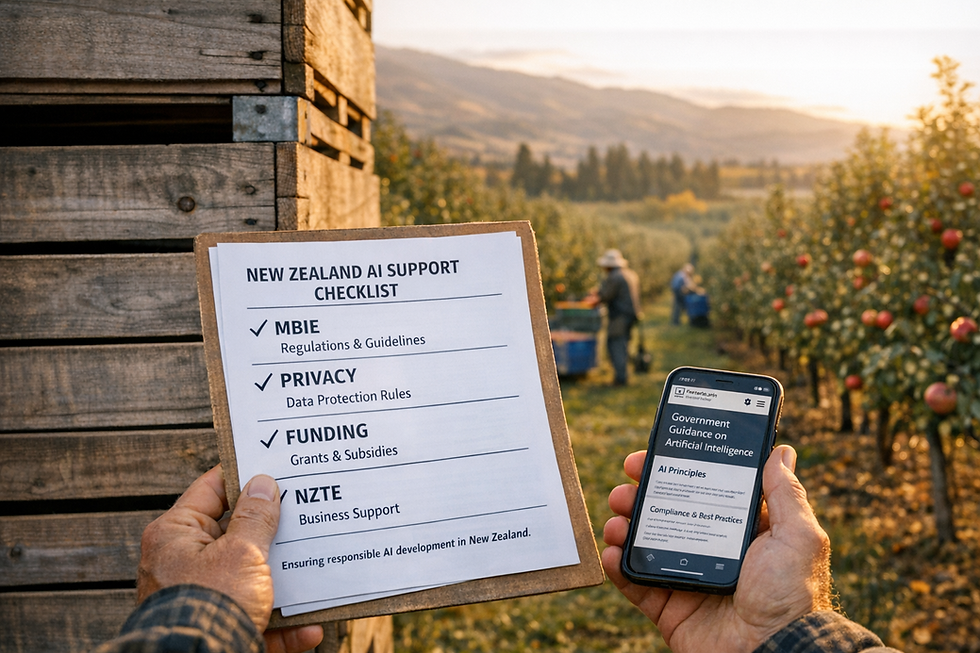
A strong first stop for AI support New Zealand small business owners can actually use is the government guidance already available online. MBIE’s responsible AI material is designed to help businesses think through risk, governance, accountability, and practical implementation questions before AI becomes embedded in day-to-day operations. It is especially useful if you are weighing up tools for customer service, marketing, internal productivity, or decision support and want a framework for using them responsibly. Start with MBIE’s responsible AI guidance for businesses, which helps you assess issues such as transparency, human oversight, data quality, bias, and how AI outputs should be checked before they influence real decisions. Pair that with the business.govt.nz summaries and digital advice, which tend to translate policy ideas into simpler, more practical steps for smaller firms. Together, these resources give you a working checklist: what problem are you solving, what data is involved, who is accountable, what could go wrong, and what controls should be in place? That makes them a good foundation before you spend money on software or consultants. Useful links: - MBIE responsible AI guidance: https://www.mbie.govt.nz/ - business.govt.nz digital technology guidance: https://www.business.govt.nz/ Next steps: - Read the MBIE responsible AI guidance and note the top three risks for your use case. - Use business.govt.nz to turn those risks into a practical action list. - Choose one low-risk AI task to pilot first.
Privacy and data support before you roll anything out
If your AI tool touches customer details, staff information, emails, forms, or transaction records, privacy needs to be part of the conversation from the beginning. The Office of the Privacy Commissioner is the key official source here, and its resources are highly relevant for any SME working under the Privacy Act 2020 AI context. The most useful starting points are the privacy principles, guidance on disclosing or storing information overseas, advice about using third-party providers, and privacy breach guidance. These help you work out whether you are collecting only what you need, whether an overseas software provider creates extra risk, and what your responsibilities are if something goes wrong. This is also the point where many businesses need to know when to bring in extra help. If you are handling sensitive personal information, integrating AI into core systems, or signing contracts with offshore vendors, it is wise to consult legal and IT security support. Official guidance is excellent for understanding your obligations, but it does not replace tailored advice on contracts, system configuration, or sector-specific compliance. Useful links: - Office of the Privacy Commissioner: https://www.privacy.org.nz/ - Privacy principles: https://www.privacy.org.nz/privacy-act-2020/privacy-principles/ - Sending personal information overseas: https://www.privacy.org.nz/privacy-act-2020/codes-of-practice-and-information-sharing-agreements/sending-personal-information-overseas/ - Guidance on privacy breaches: https://www.privacy.org.nz/your-rights/privacy-breaches/ Next steps: - Identify whether your AI project uses personal or sensitive information. - Check whether your provider stores or processes data overseas. - Get legal or IT advice before launch if the project affects customer records, payroll, health, finance, or other sensitive data.
Cloud and data residency: use the right questions, not guesswork
A common sticking point for AI training NZ SMEs and software adoption generally is data residency. Owners often hear terms like ‘hosted in Australia’ or ‘global cloud’ without knowing what questions to ask next. The New Zealand Digital Government cloud guidance is useful here, even if you are not a government agency, because it gives you a structured way to think about jurisdictional risk. Rather than treating cloud location as a simple yes-or-no issue, this framework helps you ask better questions: which country’s laws may apply, who can access the data, what subcontractors are involved, how is data encrypted, and what happens if you need to exit the provider? For AI tools that move data across borders or rely on multiple cloud services, those questions matter. This guidance is particularly helpful when comparing vendors. It gives you a decision lens so you can challenge vague sales claims and document why one option is safer or more suitable than another. Useful links: - NZ Digital Government cloud risk and jurisdiction guidance: https://www.digital.govt.nz/ Next steps: - Ask each vendor where data is stored, processed, and backed up. - Request details on subcontractors, encryption, and incident response. - Use the Digital Government framework to compare providers consistently.
Innovation funding and R&D support
If you are building something new rather than simply buying an off-the-shelf AI subscription, there may be innovation support worth exploring. In New Zealand, innovation funding and tax incentives do exist, but eligibility, programme ownership, and availability can change. That is why it is important to check live official pages rather than relying on an old article or second-hand advice. A good central starting point is Innovation Services, which acts as a hub for businesses looking into growth, capability, and innovation support. Depending on your stage and activity, you may find pathways related to research and development, expert support, or capability-building. It is also worth understanding the R&D tax incentive NZ businesses can claim in some cases. In general terms, the R&D Tax Incentive offers a 15% tax credit for eligible R&D expenditure, with thresholds and rules applying. It is most relevant where AI work involves genuine technical uncertainty and development, not just routine software set-up or buying standard tools. Because the rules matter, always review the current Inland Revenue guidance. Useful links: - Innovation Services: https://www.innovation.govt.nz/ - Inland Revenue R&D Tax Incentive: https://www.ird.govt.nz/research-and-development-tax-incentive Next steps: - Clarify whether your AI work is adoption, custom development, or formal R&D. - Check Innovation Services NZ funding pathways on the live official site. - Review Inland Revenue guidance to see whether the R&D tax incentive may apply.
NZTE support for growth and export-focused businesses

Not every business will be the right fit for NZTE, but for firms with growth ambition, export potential, or international market plans, NZTE support can be highly valuable. If you are scaling a product, preparing to enter offshore markets, or building capability to compete internationally, NZTE is often the right conversation. This is where myNZTE becomes useful. It gives eligible businesses access to tools, market insights, events, and support pathways that can help connect AI adoption to wider growth goals. For example, if AI can improve your fulfilment, customer experience, or market intelligence in ways that support export readiness, NZTE support exporters often use may be relevant. The key is fit. If you are still at the stage of learning basic AI tools for internal admin, MBIE and business.govt.nz may be more immediately useful. If you are using AI as part of a broader growth strategy, NZTE may be a better match. Useful links: - NZTE: https://www.nzte.govt.nz/ - myNZTE: https://my.nzte.govt.nz/ Next steps: - Decide whether your AI plans are mainly about internal efficiency or growth and exporting. - Explore myNZTE resources if you are scaling or export-ready. - Align any AI investment with a clear commercial outcome, not just curiosity.
Important 2026 nuance: check current programme ownership and contacts
One important point for anyone searching Callaghan Innovation AI support is that the landscape has been changing. Callaghan Innovation has been through a disestablishment and transition process, which means some programmes, contact points, and responsibilities may now sit elsewhere. This is exactly why businesses should follow official live pages rather than bookmarking old PDFs or relying on outdated blog posts. In practical terms, that means checking which agency currently owns the support you are interested in, whether the programme is still open, and where the latest eligibility criteria sit. Innovation Services may be the right hub for some enquiries, whilst MBIE, Inland Revenue, or NZTE may be the better source for others. This small step can save a lot of time. It also reduces the risk of planning around support that has moved, changed, or closed. Useful links: - MBIE: https://www.mbie.govt.nz/ - Innovation Services: https://www.innovation.govt.nz/ Next steps: - Verify every programme on the current official website before applying. - Confirm the latest contact point before booking advisory support. - Treat any older Callaghan Innovation references as historical unless confirmed otherwise.
AI adoption does not have to be a leap into the unknown. For New Zealand businesses, there are credible places to get started: MBIE responsible AI guidance for structure, the Privacy Commissioner for Privacy Act 2020 AI questions, Digital Government guidance for cloud and data residency decisions, Innovation Services NZ funding pathways for innovation activity, and NZTE support for exporters and scaling firms. The right path depends on what you are trying to achieve, how sensitive your data is, and whether your focus is efficiency, innovation, or growth. Download the NZ AI Support Directory, then contact us to plan your next 90 days.


